|
|
The Nathaniel Fellows Chapter, Daughters of the
American Revolution was named after Nathaniel Fellows, Sr.,
who was not only a veteran
of the Revolutionary War but one of the first settlers in Coralville
(Johnson County), Iowa. He is one of only 19 Revolutionary War
soldiers buried in Iowa.
Mr. Fellows was born in 1758 in Dorchester, New
Hampshire, the son of a revolutionary soldier, Captain Samuel
Fellows. At the age of 17, Nathaniel enlisted and served as a
private in Col. Beldell’s regiment. The regiment was given the
Order of Congress to harass the British by invading Canada and
carrying out daring raids. They had hoped to liberate all of North
America from British rule. Even though the mission failed,
Nathaniel had shown great fighting spirit.
At the age of 24, Nathaniel married Mercy
Flanders, the
daughter of a revolutionary soldier. They had four
children - Nathaniel Fellows, Jr., Elizabeth, Judith, and Mercy.
Nathaniel's wife, Mercy, died in New Hampshire in 1836.
In the spring of 1837, the Fellows’
family consisting of Nathaniel Sr. age 79, his son Nathaniel, Jr.
age 47, his daughter-in-law Polly and two children, loaded an ox
wagon with all their belongings and left New Hampshire to journey
westward. The family had no destination in mind but simply planned
to travel until they found the “right” land and water. They
traveled by wagon train across the states of New York, Pennsylvania,
and Ohio. Late in 1837 they arrived in Portage, Indiana where they
ran out of food and money. The two men were cobblers by trade, and
they set up shop to make and mend shoes for travelers. The men
charged $1.50 for a pair of high top shoes, $2.50 for a pair of
fancy boots and $.63 for mending shoes. They were able to build up
their finances for the continued trip westward.
The following spring, 1838, they joined a train
of 40 ox teams and continued moving west. They crossed the state of
Illinois and crossed the Mississippi River at what is now Muscatine,
Iowa. There, the family left the ox train and followed a rough road
with ruts and mud holes that slowed their progress. They finally
came to the Iowa River.
Traveling along the east bank of the Iowa River,
they came to a spot opposite Indian Lookout just south of what is
now Iowa City, Iowa. Here Chief Poweshiek and his Sac and Fox
Indians had their camp. The family had hoped to ford the river, but
soon realized the river was swollen and current too swift for
fording. They needed help to cross and without a ferry or any other
white men in the area, they turned to Chief Poweshiek and his
people.
While Chief Poweshiek was unlikely to harm a
white man, he was adamant that he would not allow any settler to
cross the Iowa River to the land he controlled on the other side.
There is no known account of the meeting between Poweshiek and the
Fellows family but it probably was tense at first. The family
parleyed with Poweshiek and apparently impressed him enough that he finally granted the family
permission to cross the river so they could push westward into land not
yet open to white settlers. For $1.00, an Indian brave carried
the family across in his canoe, one person at a time. It took them
all day. Nathaniel drove Buck and Bright, his oxen team, and
his milk
cow across the water. The wagon was completely dismantled and with
its contents, ferried across the water piece by piece.
They had carried the contents of their wagon a
thousand miles and most of the belongings were important for their
survival. They had corn, wheat, oat, vegetable seeds and potatoes.
They had the tools to plant, harvest and clear the land: scythes, a
grain cradle an ax, a grindstone, and a crude plow. Mrs. Fellows
had her spinning wheel, shears and sewing tools, cooking implements
including her “spider” - a long handled skillet with legs – and her
“starter” for bread. She also had her herb medicine for combating
illnesses. All of which was transported across the river that day.
At the end of the day, they camped just south
of the present day Iowa City Airport. On the morning of May 6,
1838, the Indians helped reassemble the wagon. According to his
daughter Elizabeth, that morning Nathaniel told his wife, Polly, he
was going to “walk to the top of the ridge” and see if there was a
valley or timber on the other side. When he came back he told the
family it was a good place to go and so they hitched the oxen to the
wagon and traveled over the ridge. At the top of the ridge, they
had one more encounter with Indians – a band of 50 – that scared the
family and the oxen but did not stop them from continuing with their
journey.
At Clear Creek, now Coralville, they took
notice of the unusually, clear, clean water in the stream and the
family was captivated by the rich bottom land adjoining it. These
factors prompted a decision to make this their home. Here they made
camp, broke ground for planting of corn and potatoes. They found
one other white man, Bowen Wright, living nearby in a small hut
built out of tree bark. He was a hunter and a trapper and had been
there a short time. He helped the family build a 10 x 12 foot
cabin. Clear Creek provide them with drinking water and Wright kept
them in venison and wild game.
Nathaniel Fellows, Sr., who was not yet 80
years old, became weak from the hardships of the two successive long
journeys and died on July 12, 1838. Bowen Wright helped Nathaniel Jr.
build a casket from a walnut tree. They had no nails or screws so
they pinned it together with wooden pegs. Original internment was
at the center of what is now old Highway 6 and 5th St in
Coralville.
For three years the Fellows family lived
peaceably beside the Indians until in 1839 Chief Poweshiek moved
his people to a new village in the west part of the county.
Poweshiek granted the Fellows family the 260-acre farm they had
staked out. Because it was a gift from the Indian chief, it was not
entered into the Federal Records until it was surveyed much later.
The land transaction was unique for the state of Iowa. The farm later
became known as the Evergreen farm and was owned by the Dennis
family - Isaac Dennis having married Elizabeth Fellows in 1843.
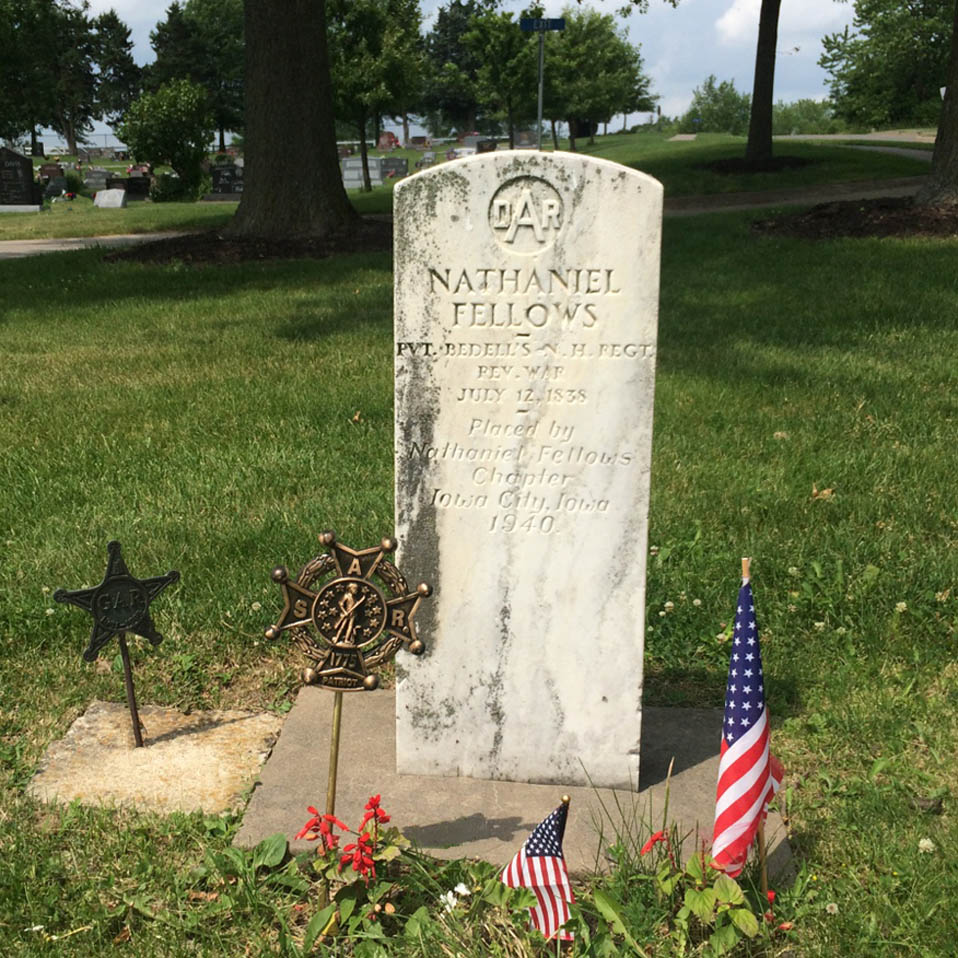
In November 1940, the Nathaniel Fellows Chapter
DAR dedicated and presented a permanent marker to State of Iowa for
the gravesite of Nathaniel Fellows, Sr. The Iowa Highway Commission
maintained the marker until 1971 when the commission informed the
chapter that they could no longer maintain the marker due to the
relocation of Highway 6. The chapter applied for, and received
permission from, the City of Coralville to move the marker to Oak
Hill Cemetery, just inside the entrance. The City of Coralville moved the
marker to the present day site.
|

 |
 |
 |
| |
DiAnne Lerud-Chubb
Iowa
State Regent
National Motto
"God, Home, and Country"
National Theme
"The Spirit of Hospitality Opens Doors of
Opportunity"
2006-2008 StateTheme
"Iowa Daughters Live Our Revolutionary
Heritage From the Mississippi to the Missouri River"
|
|
 |
 |
 |
|