The charter was sent for October 4, 1893, signed by Miss Eugenia Washington, Secretary General, NSDAR, and a check for $5 payable to the Treasurer General, NSDAR, was sent in payment of fee for the charter for Abigail Adams Chapter, Des Moines, Iowa. Chapter name, Abigail Adams. Date of Organization, August 17, 1893. Charter 54. Place, Des Moines, IA.
The organizing members were Sophia M. Dolson Andrews, Carrie M. Ogilvie, Alice A. Crawford, Elizabeth Brown Howell, Ella Lyford Warfield, Edith Hepburn Thummell, Hortense Bailey Vail, Ardella J. Pratt, Mary J. Loomis Gaylord, Mary Helen Baylies Peters, Lillian Monk, Antoinette Graber, and Mattie Locke Macomber. Carrie was the organizer of Abigail Adams Chapter, and put in several months of concentrated efforts to interest women of the city of 50,000 (approx.) population and surrounding counties to form a chapter of NSDAR, the national organization having been formed October 11, 1891. It was incorporated under the laws of Congress applicable to the District of Columbia, thus the national headquarters was fixed in that city. Carrie put notices in the local press and county papers that she would have open house at various times to explain the objects and aims and the necessary proof of being eligible, and help in securing this needed proof. Her ‘dream child’ came into being in her home in May, 1893. She was rewarded for her efforts by a happy consummation of her plans when at this time fifteen (15) ladies started the formation of a chapter.
Carrie Ogilvie was elected as the first regent
by a national board but she declined and said the office should
go to Mrs. Sophia M. Andrews, whose father was in the
Revolutionary War making Sophia a real Daughter. She was
given the office of first secretary, and then was elected regent
the next year by the chapter. Sophia Andrews'
father, John Dolson (or Van Dolson), was one of the Minute Men
of the Revolution and served as a soldier during the whole of
the war. He was with Washington at the Battle of Trenton,
Christmas night, 1776; in the Battle of Saratoga when Burgoyne
surrendered; in the Battle of Yorktown when Cornwallis was
defeated, and many other battles. He received a pension
for his service in the war and his name is in the records of the
Bureau of Pensions, Department of Interior, Washington,
D.C. Further information
about the notable women of Abigail Adams Chapter NSDAR
|
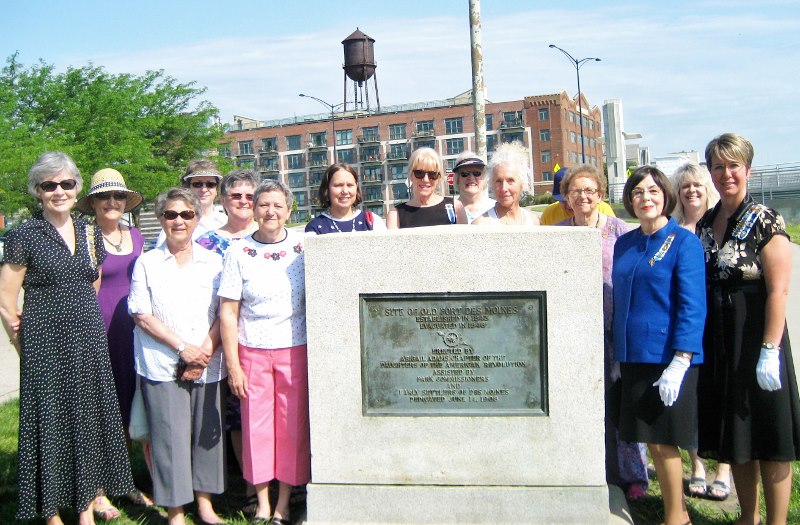
The highlight of 1908 was the dedication of the stone marker on the site of the second Old Fort Des Moines, at the northeast corner of the children’s playground at First and Elm Streets. Directly behind the monument was a flag staff from which the Stars and Stripes were to wave on all fair days. The bronze tablet is pictured at the right. The site was selected by Isaac Brandt, a member of the Park Commissioners, who had assisted with the project, and Mr. Brandt said, “Every streetcar going to New Fort Des Moines will pass this monument of the Old Fort.” He was one of the oldest residents of the city, and he was selected by Abigail Adams to locate the site. The ceremony was military in nature under the command of Colonel West of 2nd U.S. Cavalry. |
 |
|
Residing in the third and last Fort
Des Moines, the 2nd Cavalry sat on their
mounts with sabers drawn in salute, and the 2nd
Cavalry Band on their white mounts played the "Star
Spangled Banner." Mrs. D. W. Skinner, a past
regent under whom this project was started, at the
same time as the band played, unveiled the marker by
hoisting Old Glory to the top of the flag staff.
As the band finished, Mrs. Skinner pronounced these
words: “On behalf of Abigail Adams Chapter, I
present this memorial to the City of Des
Moines.” On either side of her were Colonel West
and the regent of that date, Mrs. Kasson Miller. |
 |
In 1938, a second bronze plaque
was added to the north face of the Fort Des Moines
monument: "Here passed the Dragoon Trail,
blazed in 1835 by the First U.S. Dragoons under
Colonel Stephen W. Kearney. Marked by
Iowa Daughters of the American Revolution 1938. |
|
A letter dated April 13, 1908, to Abigail Adams Chapter, reads thus: “No. 32 General Assembly had made an appropriation whereby the flags which were carried by the 4th Regiment and other troops from Iowa during the Spanish American War are to be placed in a case in the rotunda of the Capitol Building, sets April 25, 1908, as date of ceremonies of placing said flags in cases, and as said flags were presented to the 51st Iowa Infantry by Abigail Adams, it affords the Committee great pleasure to extend to you a cordial invitation to be present at said ceremonies to participate with us in placing these colors in their last resting place. W. H. Thrift, Adj. Gen. – John Loper, Late Co. 51st Iowa Infantry, U.S.A. |
 |
On November 8, 1926, the meeting was given over to the planting of a Henry C. Wallace memorial tree on the lawn of Hoyt Sherman Place. Henry C. Wallace had been a leader of Des Moines civic activities, especially the YMCA and the Red Cross. He helped establish 4-H and extension programs in Iowa. He was a publishing partner and editor of Wallace's Farmer magazine. In 1921, he became U.S. Secretary of Agriculture. Report of the recording secretary indicates that "The Chapter is indebted to Mrs. and Mrs. C. E. Hunn for the tree and stone that holds the bronze plate identifying the spot." |
|
In December 1933, a place marker was dedicated and presented to the city of Des Moines. The three-ton boulder of pink Minnesota granite bears the bronze DAR insignia in one corner and was located to form the central point of interest in the city beautification plan. The boulder was placed between the Municipal Building and the Armory to be erected by the American Legion. It is pictured at the left. |
|
|
|
On October 8, 1934, Abigail Adams Chapter opened its season by dedicating a bronze tablet at Hoyt Sherman Place. The tablet was presented to the city of Des Moines and accepted by Mayor Dwight Lewis. Later it was placed on a building on the northeast corner of 9th and Locust and marked the site of the first public school building in Des Moines. |
|
In an 18-month long project, the five DAR historical markers in downtown Des Moines were restored to their original elegance. Exciting development in the core of the city made this the ideal time. Construction of the Principal Riverwalk, a weekly Farmers Market on Court Avenue, and the extension of M.L. King Parkway, all bring much higher visibility of our Fort Des Moines and Dragoon Trail. monuments. North on the river,
creation of Brenton Skating Rink,
renovations at Des Moines Botanic Garden,
and the new landmark footbridge, have
greatly increased public traffic at the
Grand Avenue boulder monument, as
well. Hoyt Sherman Place, a mansion
cum theater, is pivotal architecture in the
historic Sherman Hill neighborhood.
Our memorial to Henry Wallace sees
almost-daily crowds on the lawn of this
venue for concerts, lectures, receptions,
and ceremonies. |

